
Tropilaelaps Mites
July 2026
Written by: Leilani Pulsifer
Edited by: Nuria Morfin & Muhammad Fahim Raza
Tropilaelaps mites (Tropilaelaps spp.) are an ectoparasite that feed on the haemolymph of honey bee larvae and pupae. There are four species in the genus Tropilaelaps including T. clareae, T. mercedesae, T. koenigerum, and T. thaii. The first two species, T. clareae and T. mercedesae, are known to parasitize the western honey bee (Apis mellifera). These mites share many similarities to varroa mites (Varroa destructor); however, their fertility is higher and their life cycle is shorter than that of varroa. This lends to their rapid reproductive rate, which is of major concern to beekeepers. Like varroa, tropilaelaps are vectors of diseases such as deformed wing virus. This, in tandem with their fast reproductive rate, is why tropilaelaps mites can cause 50% larvae mortality, which greatly impacts the population and health of the colony [1].
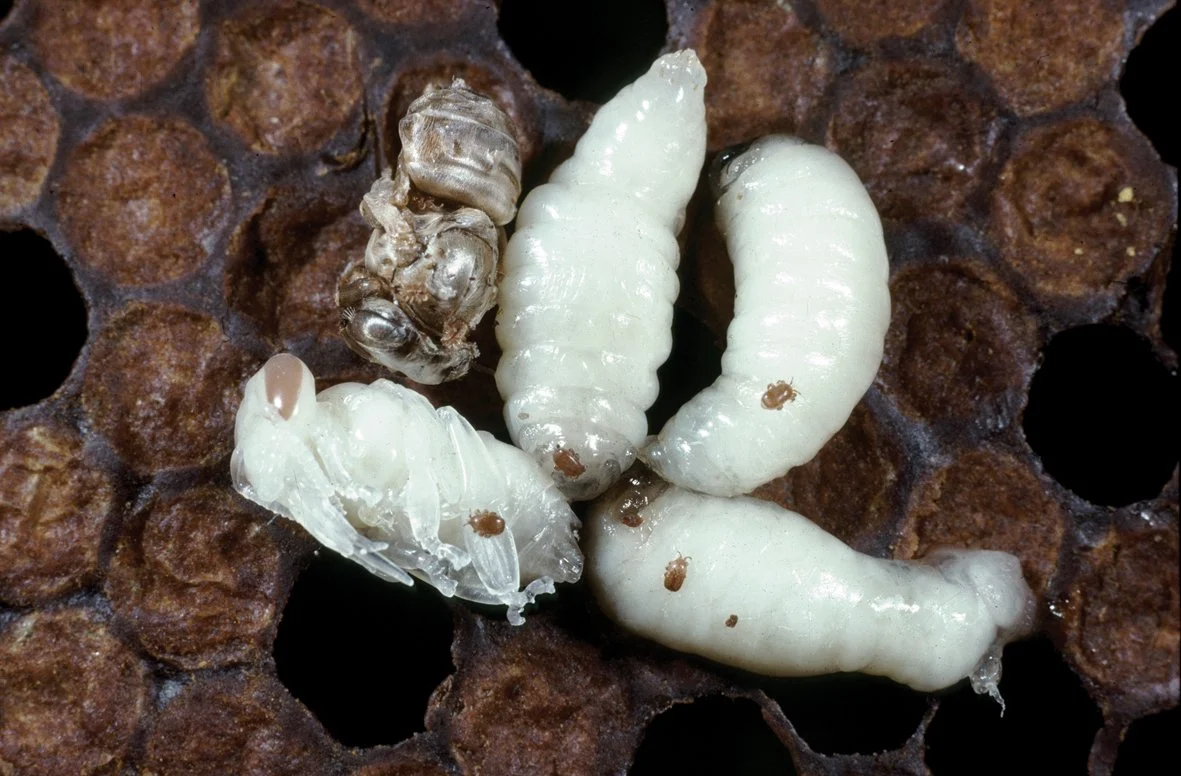
Tropilaelaps mites on honey bee larvae and pupae [2].
Distribution
Tropilaelaps mites originate from Asia and can be found in India, Pakistan, Eastern Korea, Northern China to South Indonesia including Papua New Guinea, Malaysia, Myanmar, Nepal, the Philippines, Sri Lanka, and Thailand [3]. In more recent years, mite populations have become established in Russia, Georgia, and Uzbekistan. Additional reports indicate that mites are also present in Bhutan, Iran, and Kenya [4, 5]. As of 2026, tropilaelaps mites are not present in North America. However, because of international imports, there is the risk that these mites may be introduced in the future. It is in your best interest and for the betterment of your operation and the operations in your surrounding area to stay educated and up to date on these pests.
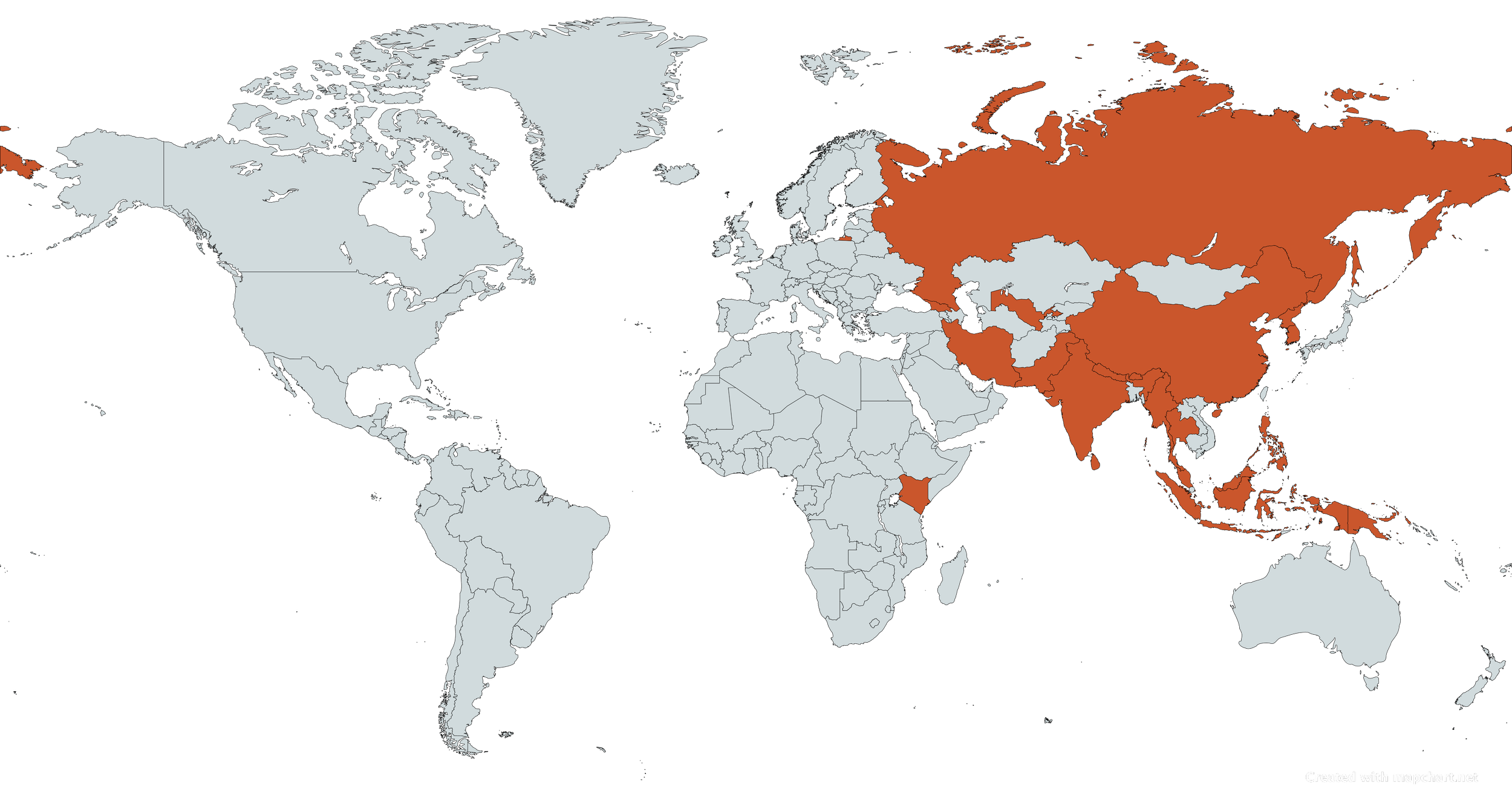
2026 global distribution of tropilaelaps mites [6].
Lifecycle
The lifecycle of tropilaelaps mites is similar to varroa – they both have a reproductive phase and a dispersal phase (also called the phoretic phase). During the reproductive phase, a female tropilaelaps mite (foundress mite) enters a honey bee brood cell that is about to be capped. She then lays 1-4 eggs which will hatch within 12 hours of being laid – both females and males. During their development, the mite larvae feed on the haemolymph of the honey bee pupae. Typically, the daughter mites will mate before exiting the cell, but mating can occur in open cells or even outside of the brood cell. When the honey bee has finished developing and exits the cell, this triggers the start of the dispersal phase.
The phoretic phase is when the fully developed mites spread. As the adult bee emerges from its cell, the tropilaelaps mites will attach themselves to the bee for a ride, but unlike varroa, they are unable to feed on them, so their lifespan is very short outside of a cell - more research on this topic is needed for confirmation. During this phase, the mites can transfer to other cells and hives, infecting other colonies and potentially other apiaries. Since there is a brood break over the winter in Canada (and tropilaelaps mites require brood cells to survive and reproduce), it was previously assumed that tropilaelaps mites may not be able to survive the winter. However, this hypothesis has been questioned lately as some areas where tropilaelaps have become established are assumed to have winter brood breaks [7].
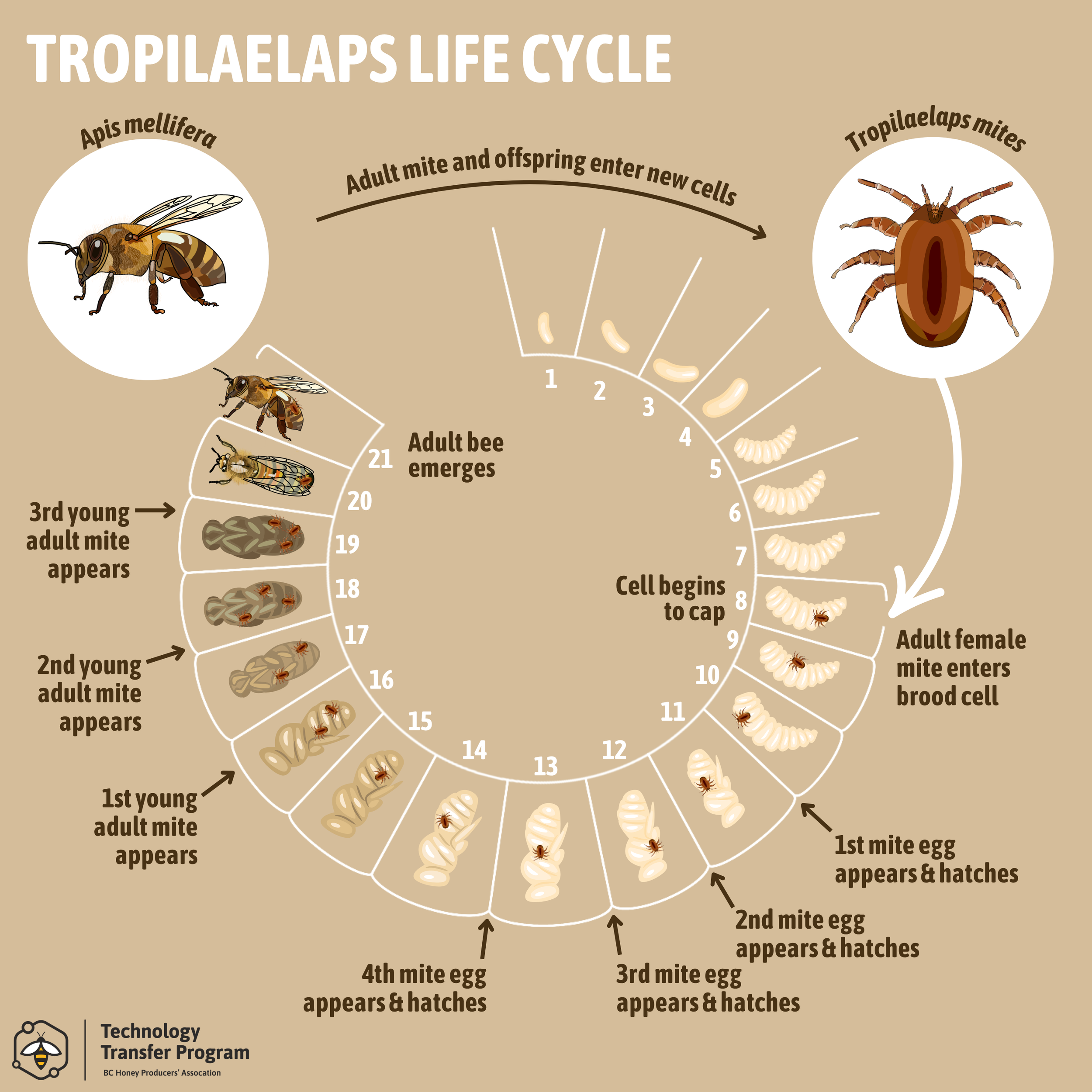
Tropilaelaps mite lifecycle.
Lookalikes
Not all pests of the honey bee are easily distinguishable. Tropilaelaps mites, varroa mites, and braula flies (bee louse; Braula coeca) are all pests that target the honey bee (with varying degrees of severity) and can look very similar to the untrained eye.
Beginning with the largest and perhaps most familiar, female varroa mites are a dark, reddish brown that average around 1-1.8mm long and 1.5-2.0mm wide. Braula flies, which are not considered to be a serious threat to honey bees, are smaller than varroa at 1.2-1.5mm long and 0.9-1.0mm wide. Lastly, tropilaelaps mites are the smallest of the three, sharing similar colours, and sizing in at approximately 1mm long and 0.5mm wide.
![Tropilaelaps mites vs varroa mite vs braula fly [8].](https://images.squarespace-cdn.com/content/v1/655f924e3c6eed07128edc86/61697493-3ceb-4f10-84a2-dae4e02f731d/tropivarroabraula.png)
Tropilaelaps mites vs varroa mite vs braula fly [8].
![Varroa mite (Varroa destructor) [9].](https://images.squarespace-cdn.com/content/v1/655f924e3c6eed07128edc86/bccb0ade-f75b-42a0-899a-286db4e4c50b/varroamite_size.png)
Varroa mite (Varroa destructor) [9].
![Braula fly (Braula coeca) [10].](https://images.squarespace-cdn.com/content/v1/655f924e3c6eed07128edc86/e6bc50dc-2940-4201-87e9-2702fb1b7395/braulafly_size.png)
Braula fly (Braula coeca) [10].
![Tropilaelaps mites (Tropilaelaps clarea) [11].](https://images.squarespace-cdn.com/content/v1/655f924e3c6eed07128edc86/2d695c73-d6b5-402f-bbc5-7546f6ad5ec5/tropilaelapsmite_size.png)
Tropilaelaps mites (Tropilaelaps clarea) [11].
Since tropilaelaps have yet to establish a population in North America, there are currently no recommendations or registered products to control this pest. In Asia, active ingredients of products that are used to treat tropilaelaps mites include tau-fluvalinate, flumethrin, amitraz, formic acid, sulfur, and coumaphos [12]. Despite tropilaelaps mites not currently being present in North America, it is vital to be able to identify this pest and understand how great a threat they are to honey bees. Take the time to remain informed so that if tropilaelaps make their way to North America, we can all be proactive in our response.
If you want to learn more about tropilaelaps mites, varroa mites, and other common threats to honey bees, check out our online course, Diseases and Pests of the Honey Bee.
References
[1,7] World Organisation for Animal Health. (2021). Chapter 3.2.6. Infestation of honey bees with Tropilaelaps spp.https://www.woah.org/app/uploads/2021/03/3-02-06-tropilaelaps.pdf
[2] Anderson, D. (2007, October 1). Asian bee mites, Tropilaelaps sp., on European honey bees, and a deformed bee (top left) [Photograph]. Wikimedia Commons. https://commons.wikimedia.org/wiki/File:CSIRO_ScienceImage_7018_Asian_bee_mites_Tropilaelaps_sp_on_European_honey_bees_and_a_deformed_bee_top_left.jpg

[3]Pollinator Partnership. (2024). Tropilaelaps: A growing threat to honey bees: What you need to know [PDF]. https://www.pollinator.org/pollinator.org/assets/generalFiles/Tropilaelaps-2-Pager-2024.pdf
[4] Tokach, R., Seshadri, A., Rogers, S. R., Chuttong, B., Jung, C., & Williams, G. R. (2026). Global range of Tropilaelaps mercedesae. Journal of Apicultural Research. Advance online publication. https://doi.org/10.1080/00218839.2026.2645867
[5,12] de Guzman LI, Williams GR, Khongphinitbunjong K, Chantawannakul P. Ecology, life history, and management of Tropilaelaps mites. Journal of Economic Entomology. 2017 Apr 1;110(2):319-32.
[6] MapChart. (n.d.). World map: Simple. https://www.mapchart.net/world.html
[8,10] Ellis, J. D. (n.d.). Braula at honey bee [Photograph]. Wikimedia Commons. https://commons.wikimedia.org/wiki/File:Braula_at_honey_bee.jpg
[9] San Martin, G. (2017, May 1). 7-Varroa destructor on head bee pupa3 by Gilles San Martin [Photograph]. Wikimedia Commons. https://commons.wikimedia.org/wiki/File:7-Varroa_destructor_on_head_bee_pupa3_by_Gilles_San_Martin.jpg
[11] Anderson, D. (2007, October 1). Asian bee mites, Tropilaelaps sp., on European honey bees, and a deformed bee (top left) [Photograph]. Wikimedia Commons. https://commons.wikimedia.org/wiki/File:CSIRO_ScienceImage_7018_Asian_bee_mites_Tropilaelaps_sp_on_European_honey_bees_and_a_deformed_bee_top_left.jpg