
Implemented marker-assisted selection tools in breed populations of British Columbia
This project has been sponsored by:


Dr. Nuria Morfin
PhD | Chair of the Technology Transfer Program, British Columbia Honey Producers Association; Assistant Professor, Department of Entomology, University of Manitoba

Dr. Muhammad Fahim Raza
PhD | Chair of the Technology Transfer Program, British Columbia Honey Producers Association; Assistant Professor, Department of Entomology, University of Manitoba , PhD| Technician in Apicultural Research, Technology Transfer Program
Collaborators

Dr. Leonard Foster
PhD | Professor and Head of the Biochemistry and Molecular Biology Department, University of British Columbia
Objectives
The contribution of honey bees (Apis mellifera) as pollinators of crops is estimated to be $538 million in British Columbia (AF, 2019) and there is still a high demand for pollination services in the province, including an unfulfilled requirement of 30,000 honey bee colonies for blueberry pollination (BCBBC, 2021). However, the beekeeping industry faces challenges, including high overwinter colony mortality, existing and emerging pests and diseases, and unpredictable climatic conditions (Vidal-Naquet, 2015).
Considering the many challenges that beekeeping is facing, the establishment of a selective breeding program in BC using marker-assisted selection would support the economic growth and development of the industry (BC-TTP, 2022). Marker-assisted selection has greatly advanced animal production in many domestic species, and honey bees should not be the exception (Dekkers, 2004). However, due to the biology of honey bees (haplodiploid sex determination, polyandry, and mating in the air) the selection of traits of economic importance is not trivial.
Two of the traits that have been identified as high priority for bee breeders are hygienic behaviour and low Varroa destructor population growth, as they could be the first line of defense against diseases that have a negative economic impact for beekeepers (Guichard et al., 2023). British Columbia has a great potential to increase the honey bee stock and select for traits that are relevant to beekeepers in the province. When establishing a breeding program, it’s relevant to consider the inherent genetic constitution of the population of bees and their interaction with their particular environment (e.g. climatic stress and prevalence of pathogens) and develop strategies with beekeepers to increase the genetic potential of desirable traits. Therefore, we propose to implement the use of molecular markers in honey bee colonies selected for disease resistance in British Columbia, and advance marker-assisted selection strategies.
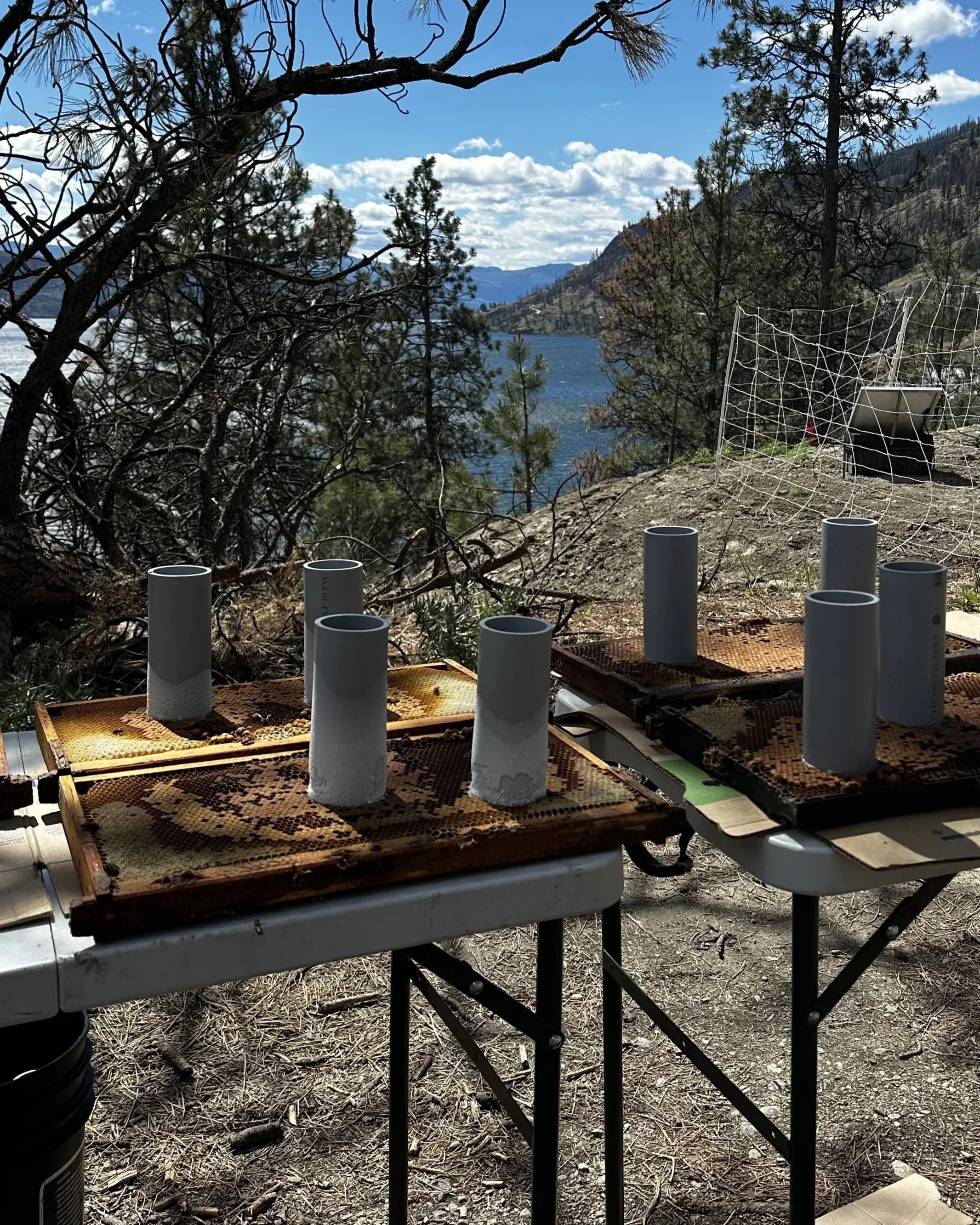
Liquid nitrogen testing.
The specific objectives of this study are to:
a) evaluate colonies used for selective breeding in three regions of British Columbia (Okanagan, Kootenay, and Nechako) for hygienic behaviour and low V. destructor population growth and assess the expression of candidate molecular markers (peptide biomarkers and DNA sequences) in worker bees sampled from experimental colonies,
b) conduct visual inspections to identify brood diseases, and sample larvae and adult bees to determine pathogen presence and levels, including pathogens that have been negatively correlated with high expression of hygienic behaviour and low V. destructor growth, including European foulbrood (EFB) and deformed wing virus-A (DWV-A; Palacio et al., 2000; Morfin et al., 2023),
c) use molecular markers to predict the performance of honey bee colonies selected for hygienic behaviour and low V. destructor population growth, by comparing them to an unselected population, and
d) analyze the performance of the molecular markers and create standard operating procedures to advance marker-assisted selection programs in British Columbia.
Length of Project
Proposed end date of March 2026.
References
BC Blueberry Council (BCBBC). (2021). Annual report. Available at https://www.bcblueberry.com/sites/default/files/2022-06/Annual%20Report-%20Final.pdf
BC Technology Transfer Program (BC-TTP). (2022). Sustainable beekeeping and domestic stock production in British Columbia.
Dekkers, J. C. (2004). Commercial application of marker-and gene-assisted selection in livestock: strategies and lessons. Journal of Animal Science, 82(3), E313-E328.
Guichard, M., Phocas, F., Neuditschko, M., Basso, B., & Dainat, B. (2023). An Overview of Selection Concepts Applied to Honey Bees. Bee World, 100(1), 2-8.
Morfin, N., Harpur, B. A., De la Mora, A., & Guzman-Novoa, E. (2023). Breeding honey bees (Apis mellifera L.) for low and high Varroa destructor population growth: Gene expression of bees performing grooming behavior. Frontiers in Insect Science, 3, 951447.
Palacio, M. A., Figini, E., Ruffinengo, S., Rodriguez, E., del Hoyo, M. L., & Bedascarrasbure, E. (2000). Changes in a population of Apis mellifera L. selected for hygienic behaviour and its relation to brood disease tolerance. Apidologie, 31(4), 471-478
The British Columbia Ministry of Agriculture and Food (AF). (2019). Bees and bee health in British Columbia. Available at https://news.gov.bc.ca/factsheets/bees-and-bee-health-in-british-columbia#:~:text=Bees%20play%20a%20vital%20role,help%20of%20bees%20and%20pollinators.
Vidal-Naquet, N. (2015). Honeybee veterinary medicine: Apis mellifera L. 5M