
By Dr. Muhammad Fahim Raza
In 2025–2026, the BC-Technology Transfer Program (BC-TTP) continued several applied honey bee health research projects, expanded industry partnerships, and advanced online educational and field-based knowledge transfer across British Columbia. The 2026 core team consists of four members: Dr. Nuria Morfin (Chair of the Steering Committee), Becky Miller (Administrative Assistant), Leilani Pulsifer (Science Communicator), and Muhammad Fahim Raza (Technician in Apicultural Research). Additionally, in 2026, we hired two interns: Sumedha Sharma for the summer term (completed) and Sofia Meriot for the fall term (ongoing until December 2026).
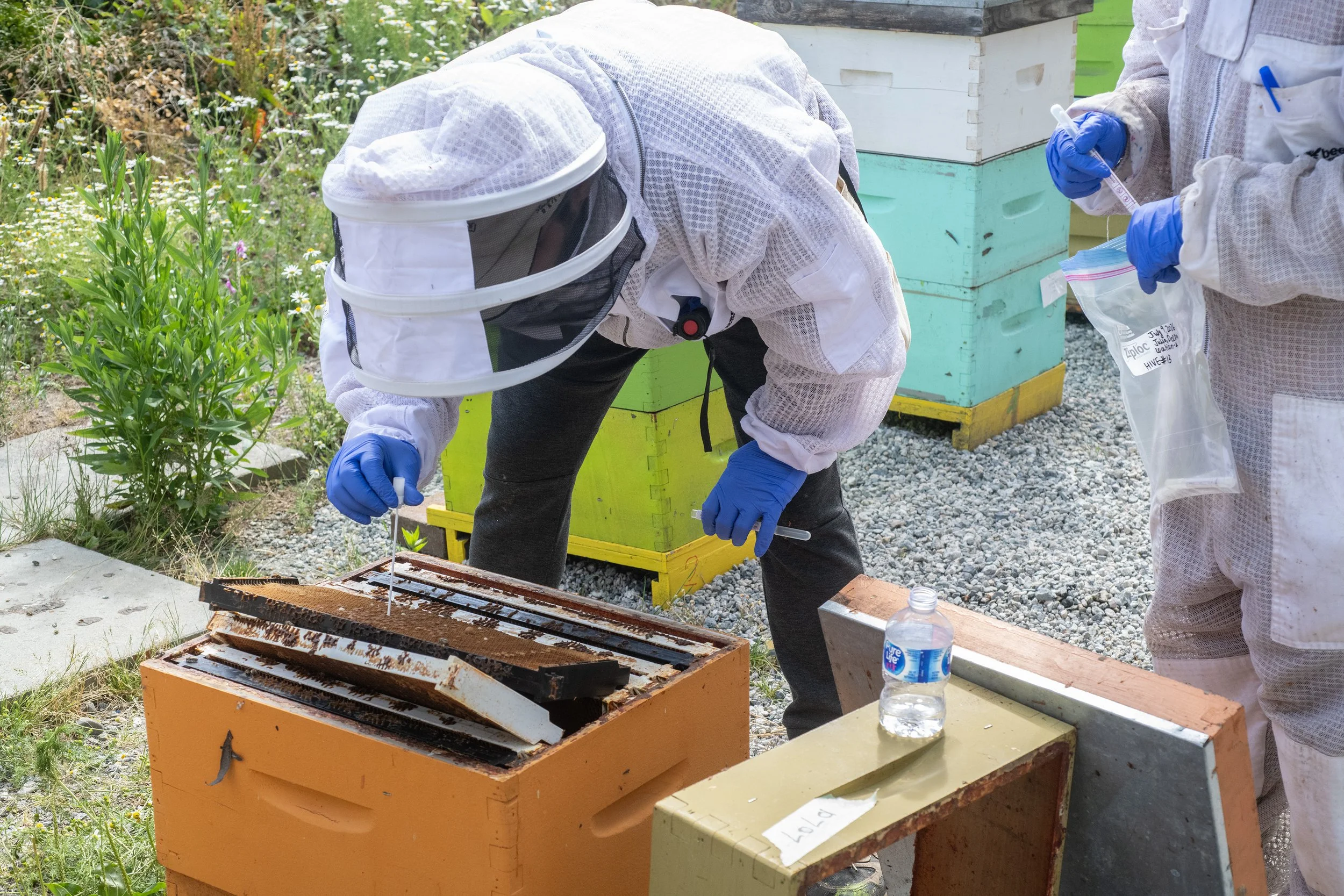
Dr. Fahim collecting larval swabs for lab-based EFB and AFB diagnosis.
The main projects for 2026 and 2027 include marker-assisted selective breeding, development of the online learning platform, and surveillance of American foulbrood (AFB) and European foulbrood (EFB). To read the full description of our ongoing projects, visit our research page.
Briefly, we have completed processing 154 honey samples collected from 73 beekeeping operations across BC as part of the first-year (2025) American foulbrood (AFB) surveillance study. Laboratory culture and PCR testing were completed at Kwantlen Polytechnic University’s Applied Genomics Centre (KPU-AGC), and diagnostic reports were confidentially shared with participating beekeepers before spring 2026. To continue this AFB surveillance project, we secured an additional CAD $20,500 from Pollinator Partnership Canada and the Storehouse Foundation (the same funders who supported our 2025 AFB surveillance study) for research continuing from March 2026 to March 2027. In 2026, we plan to collect an additional 50 honey samples from approximately 25 beekeeping operations to quantify AFB spore levels and expand the collection of isolates available for antimicrobial susceptibility testing, alongside those stored in 2025. Spore quantification from the 2026 honey samples will complement the 2025 dataset and strengthen our assessment of AFB spore prevalence across the province.
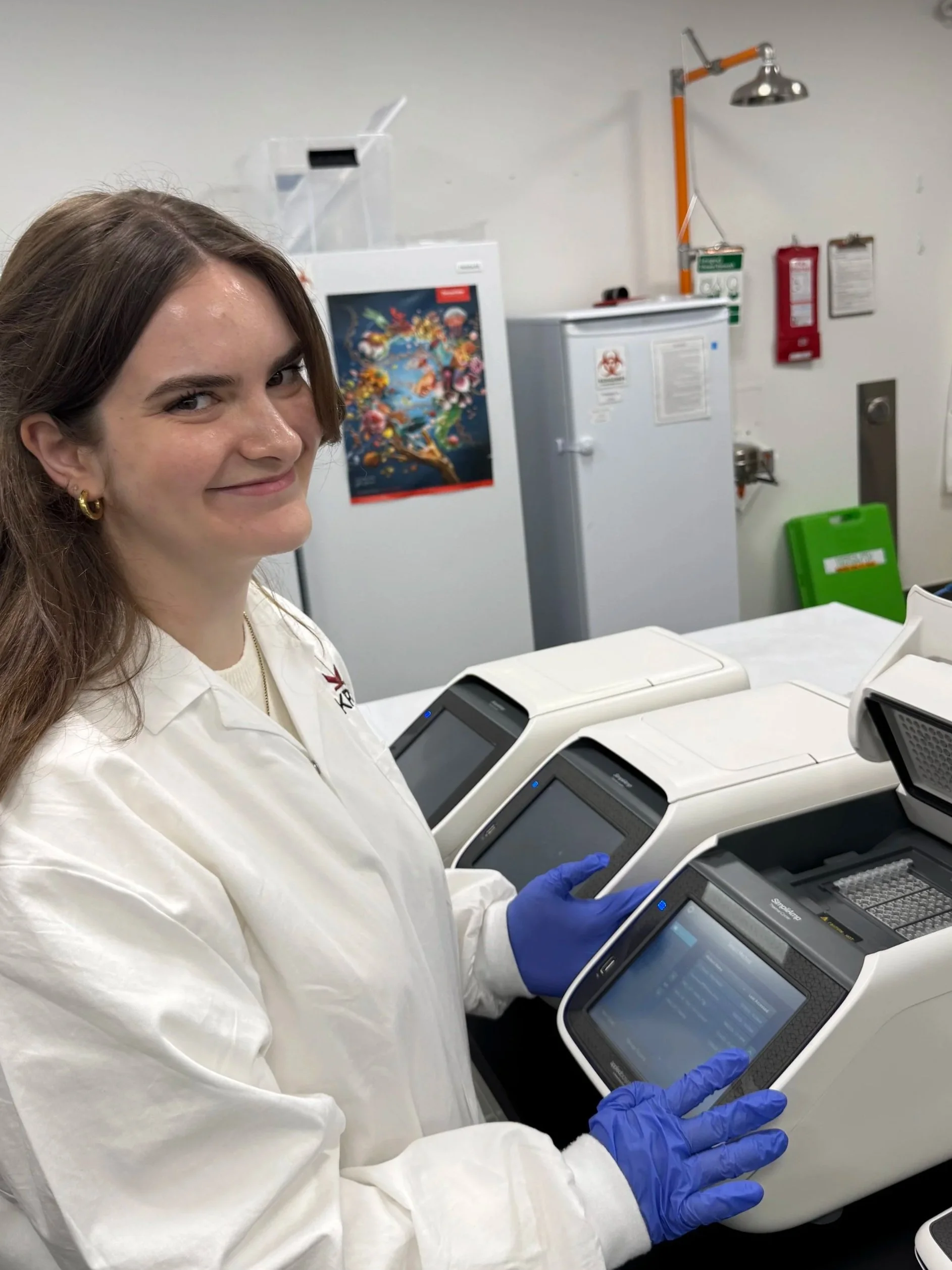
Sofia Meriot, the BC-TTP’s 2026 Fall Intern, helping out Fahim in the Applied Genomics Centre Labs, KPU.
Additionally, we have collected around 100 adult bee samples and a few suspected (EFB-like) larval swab samples from the Lower Mainland, BC, to kickstart European foulbrood (EFB) surveillance, funded by the Ministry of Agriculture and Food, BC, Canada. These samples will undergo laboratory diagnostics, including bacterial culture quantification and qPCR quantification of EFB-causing bacteria at the apiary level. We have expanded our collaboration with KPU-AGC, including an additional monetary contribution valued at CAD $31,000 solely to extend the project's research objectives to include investigations of additional bee pathogens through sequencing and targeted molecular testing.
Additional work includes selective breeding using marker-assisted selection methods to improve breeding stocks, funded by SCAP Canada. For this project, in 2026, we conducted hygienic testing in approximately 110 hives using the liquid nitrogen freeze-killed brood test and the pin-kill brood test, followed by pupal and adult bee sample collection across BC for in-depth laboratory studies. We also plan to continue developing the online learning platform for training and education. In addition to the other online courses currently available, we have recently launched a new course, Biosecurity in Beekeeping and Honey Production (click here for more information). Work is also in progress on a course focused on pollinator gardens, which is expected to be completed this year.
This year, we have supported Dr. Erika Plattner with testing and data acquisition for Varroa control acaricidal compound, 3-C, at SFU research apiaries. We are also collaborating with Dr. Leonard Foster’s lab at the University of British Columbia on a project entitled “Towards Self-Sufficiency in Apiculture for Food Security in a Net-Zero Economy.”
We acknowledge the in-kind contributions of several local beekeepers, including sample submissions and the provision of honey bee hives for above-mentioned ongoing research projects. We also acknowledge that, in addition to our existing funders, BC-TTP has previously received funding for several projects from Project Apis m., the Vancouver Foundation, and the Clean Foundation.
In 2026, we submitted research grant applications to several other organizations, including the One Hive Foundation, BeeMaid, Pollinator Partnership NAPPC, and Project Apis m., to expand our research objectives and partially support our operating costs. Unfortunately, these applications were unsuccessful in securing funding. To secure additional funding, the TTP began exploring collaborations with community-based initiatives, including pollinator gardens, while continuing to apply for research grants.
Funding is a central constraint. The current partnerships provide financial support and collaboration opportunities but do not fully cover operational needs. Current resources allow our operation to continue until October 2027. While research activities continue in 2026, other functions such as education, outreach, workshops, and general operations have been substantially affected by funding limitations. Without additional support, the program’s ability to maintain current activities and expand its work is uncertain beyond the current funding period.
A funding committee from volunteer members of the BCHPA, and commercial beekeepers association have been working to find ways to increase collaborations, seeking donations, and expanding research-based funding sources. However, success seems like a long way to go.
Keep up to date with the TTP’s projects by following us on our socials! Click the links below.