
Surveillance of European foulbrood disease through the identification and quantification of Melisococcus plutonius in brood nest bees from apiaries of British Columbia
This project has been sponsored by:

Click here for more information about the BC Ministry of Agriculture and Food.
Principle Investigator

Dr. Muhammad Fahim Raza
PhD | Technician in Apicultural Research, Technology Transfer Program
Collaborators

Dr. Nuria Morfin
PhD | Chair of the Technology Transfer Program, British Columbia Honey Producers Association; Assistant Professor, Department of Entomology, University of Manitoba

Dr. Paul Adams
PhD | Director, Applied Genomics Centre, and Faculty, Biology Department, Kwantlen Polytechnic University

Dr. Mathias Schuetz
PhD | Faculty, Biology Department, Kwantlen Polytechnic University
Objectives
European foulbrood (EFB) is a disease that kills honey bee larvae (brood) and can weaken or even kill entire colonies, especially when bees are under nutritional stress. Adult bees can carry the EFB bacteria and spread it between colonies through behaviors such as drifting or robbing, which can trigger outbreaks. In British Columbia and Alberta, EFB has recently become a serious concern because more harmful types of the bacteria have been detected. Some commercial beekeepers in BC have observed EFB-like signs in very young larvae, particularly during pollination of blueberries, but laboratory tests often come back negative for EFB. This suggests that a new pathogen may be causing these EFB-like symptoms, which affect both colony health and the effectiveness of pollination for highbush blueberries, fruits, and seed vegetables, leading to significantly reduced crop yields. Therefore, effective EFB management and identification of potential new causes of disease symptoms are essential to support healthy colonies and maintain a productive, profitable partnership between beekeepers and growers.
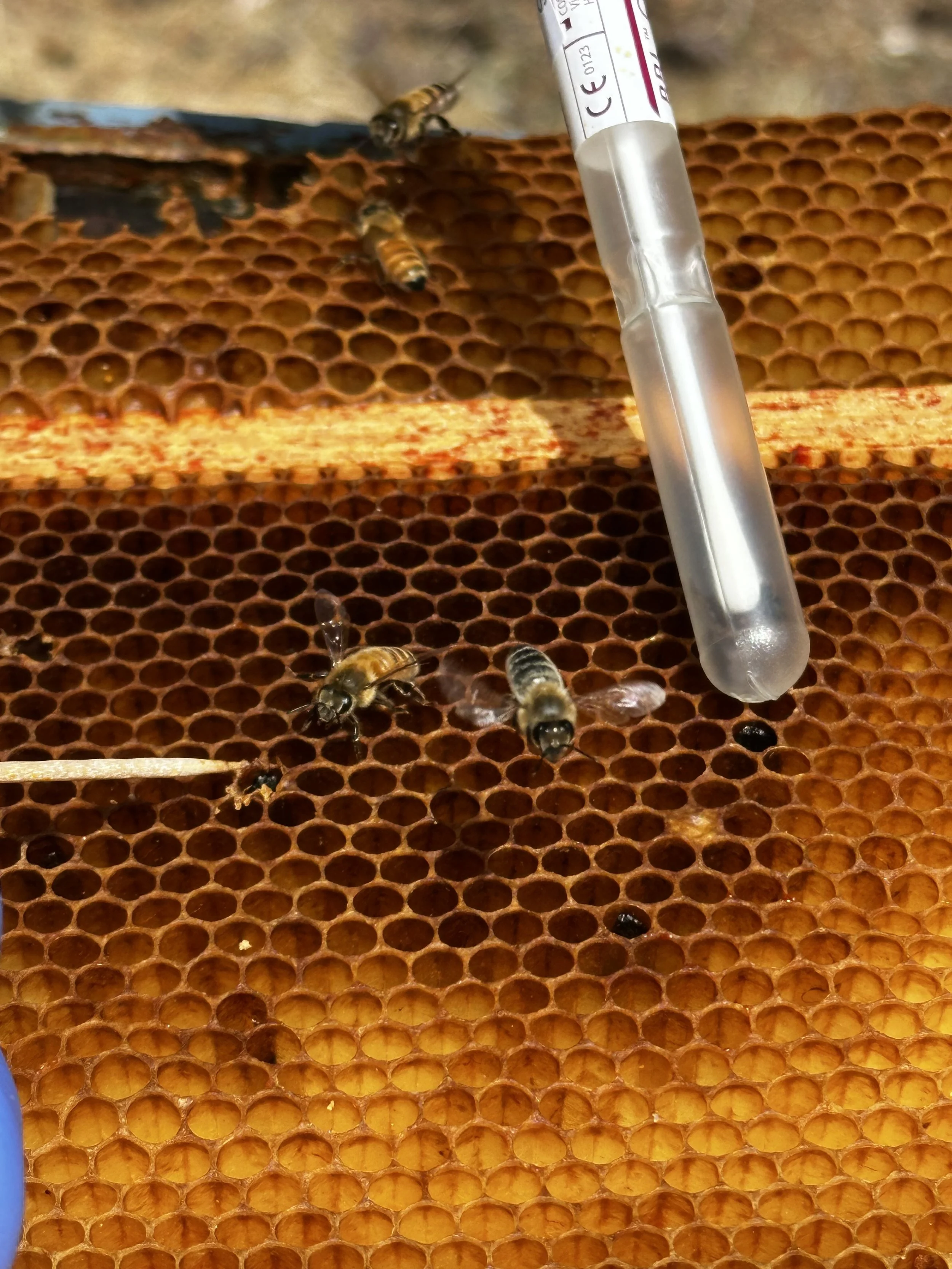
Scales of European foulbrood being pointed out by the test tube on the right.
The main objectives of this project are to:
a) determine EFB risk by measuring the number of bacteria present in adult bees (brood nest bees),
b) find out which strains of EFB bacteria are common using laboratory tests,
c) determine whether the bacteria can survive antibiotic treatments used against them,
and d) investigate why some bee larvae are dying with EFB-like symptoms and identify potential causes.
We expect to have initial results within 1–2 years, which will be shared through the BC Honey Producers Association newsletter and Education Days, the BC Technology Transfer Program social media channels and educational online platform, conferences, workshops, and other educational activities with the BCHPA clubs and branches. Practical recommendations will be provided by the end of the project.
This work will also help bring the beekeeping community together, as beekeepers will actively participate by monitoring their colonies for signs of disease, making careful decisions about antibiotic use, following best practices to keep their colonies healthy, and improving crop pollination.
Length of project
Proposed end date of May-December 2027.